
—
By
Anand Sivadasan
Founder, Das Nexus
Every year, U.S. wireless carriers underwrite and finance billions of dollars of device purchases across enormous and credit-diverse customer bases.
More than half of U.S. phone buyers now finance their device rather than pay upfront. At one national carrier alone, equipment-financing receivables recently exceeded $7 billion.
In other words, telecom companies are already in the lending business.
Yet when telecom companies expand into financial services, the conversation often starts somewhere else:
Which checking account, card, lending product or wallet should we launch—and who should we partner with to provide it?
That may start with the wrong question.
Cards in particular can become very large businesses. But the product should be the expression of the advantage, not the starting point for the strategy.
The more interesting question is:
What can a telecom company do for a customer financially that a bank or standalone fintech cannot do as well?
That leads somewhere different.
A carrier may know a customer whom the traditional financial system sees primarily through a credit file. It may have observed that customer for years: devices financed and repaid, account stability, payment behavior, household relationships, devices, SIMs and identity events.
For some customers, that information may allow the carrier to create financial value that is difficult to get elsewhere.
The proposition could be remarkably simple:
Your history with us counts.
If that helps a customer access credit when they actually need it, the carrier has done more than distribute another financial product.
It has created a reason for the customer to value the relationship itself.
That is where the fintech opportunity inside telecom gets interesting.
1. Why telcos have a right to win
Almost any company with enough customers can distribute a financial product.
Retailers can launch credit cards. Airlines can offer financial products. Telecom operators can offer checking accounts or wallets.
And distribution can be enormously valuable. Some of the world's largest co-brand card programs demonstrate that.
But distribution alone is not necessarily a structural right to win.
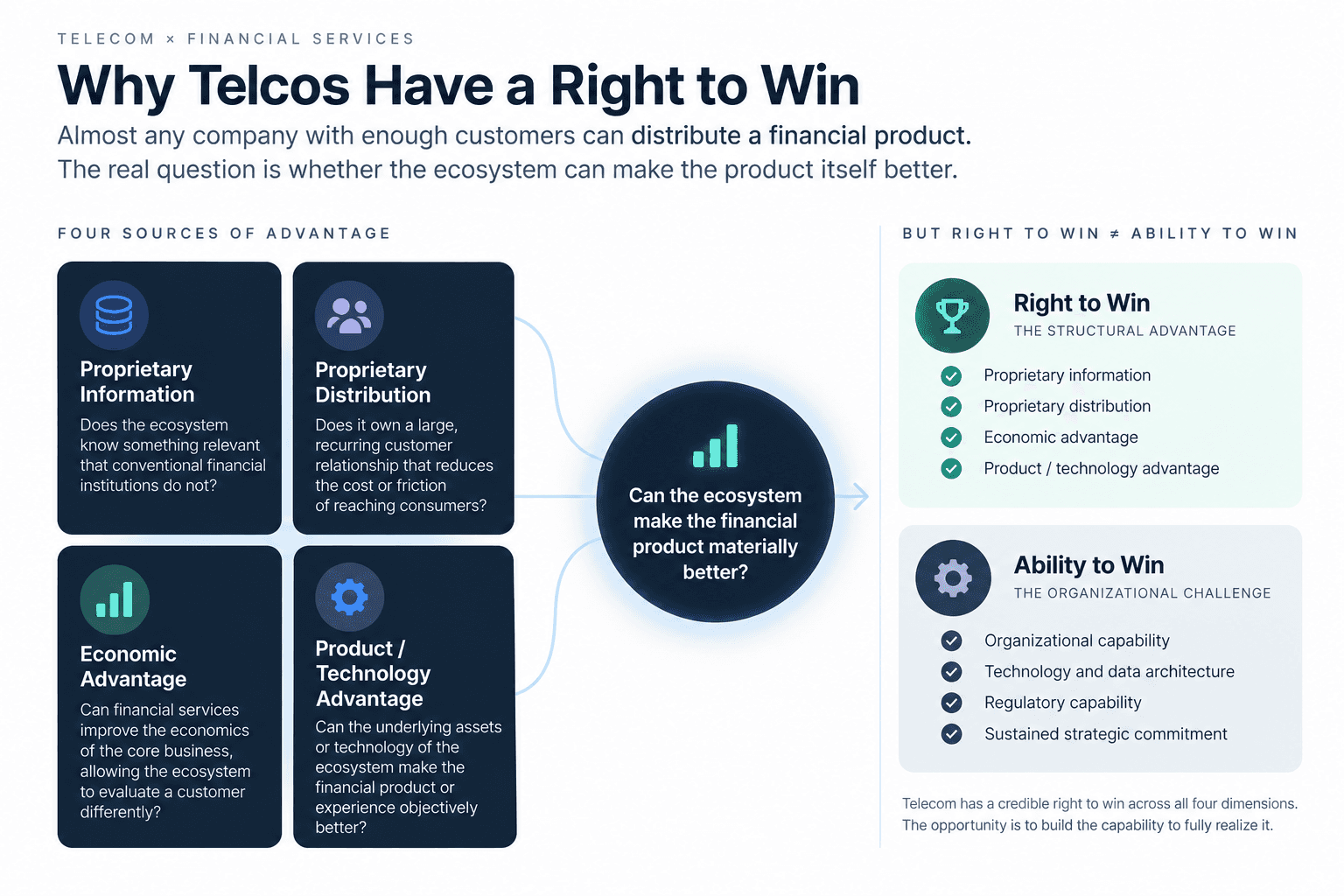
The more durable question is whether the ecosystem possesses something that can make the financial product itself better—not merely easier to distribute.
At Das Nexus, we think about that across four dimensions.
Proprietary information
Does the ecosystem know something relevant that conventional financial institutions do not?
Proprietary distribution
Does it own a large, recurring customer relationship that substantially reduces the cost or friction of reaching consumers?
Economic advantage
Can financial services improve the economics of the core business, allowing the ecosystem to evaluate a customer differently from a standalone financial-services provider?
Product / technology advantage
Can the underlying assets or technology of the ecosystem make the financial product or experience objectively better?
Telecom has a credible position across all four.
But two capabilities stand out:
credit intelligence and identity intelligence.
Credit intelligence
A carrier doesn't simply know whether someone paid last month's phone bill.
It potentially has years of longitudinal information around:
device-financing underwriting and repayment
payment timing and deterioration
customer tenure and account stability
device and upgrade behavior
household and account relationships
account changes
fraud events
the relationship between those signals and actual credit outcomes
Some telecom variables already make their way into alternative-data models.
But there is an important difference between receiving a handful of telecom attributes and owning the underlying longitudinal dataset, outcomes and ability to continuously engineer and test features against them.
That does not mean paying a phone bill automatically predicts whether someone will repay an unsecured loan.
Connectivity has unusual payment primacy. Consumers may prioritize keeping their phone connected differently from other financial obligations.
But that is precisely what makes general-purpose credit interesting: it allows the carrier to combine what it already knows with actual unsecured-credit performance and learn which signals really matter.
Cash App Score offers timely market validation
In September 2026, Block announced that it would make Cash App Score available to external lenders through Nova Credit.
Cash App Score uses millions of first-party signals across spending, saving, repayment, paycheck deposits and peer-to-peer activity to build a more dynamic view of financial health.
Block says Cash App Borrow can approve 38% more customers at the same loss rate than traditional credit scores.
That does not prove telecom information will produce the same result. Cash App begins with natively financial data, while carriers begin with a different relationship.
But it validates an important architecture:
First-party ecosystem data → proprietary intelligence → better internal decisions → richer financial identity → intelligence that can eventually become useful to other lenders.
This is closely related to the ReScore thesis we have explored at Das Nexus: moving beyond a largely backward-looking credit score toward a richer, more dynamic understanding of a consumer's financial position and trajectory.
Telecom could provide another powerful source of that intelligence.
Identity may be just as important
Credit intelligence answers:
Should I extend this customer credit, and how much?
Identity intelligence answers:
Is this actually the customer—and can I trust this interaction?
Carriers occupy a distinctive position in the identity stack:
Person ↔ Account ↔ Phone Number ↔ Device ↔ SIM/eSIM ↔ Network
That relationship can potentially contribute to:
identity verification
authentication
synthetic-identity detection
account-takeover prevention
SIM-swap and number-port risk
device and account verification
transaction fraud decisioning
Some of these signals can also be unusually timely. A device change, SIM swap or number-port event may indicate risk before a financial institution sees the resulting fraudulent transaction.
The industry is already beginning to turn these capabilities into infrastructure. By late 2025, 73 operator groups spanning 285 networks and nearly 80% of global mobile subscribers had committed to GSMA Open Gateway, which standardizes APIs for capabilities including number verification and SIM-swap detection.
The appropriate use of particular credit and identity signals will, of course, depend on consumer permission and applicable credit, privacy and regulatory frameworks.
But put the two capabilities together and telecom potentially possesses something unusual:
A proprietary view of both creditworthiness and identity.
Right to win is not the same as ability to win
There is an obvious objection.
If carriers have possessed these advantages for years, why haven't they already built enormous financial-services businesses around them?
Because possessing a right to win and possessing the organizational capability to exercise it are different things.
Right to win
proprietary information
proprietary distribution
economic advantage
product / technology advantage
Ability to win
organizational capability
technology and data architecture
regulatory capability
sustained strategic commitment
Financial services historically isn't core to most telecom organizations. Credit, billing, identity, fraud and network information can sit across different systems and teams. The financial economics and the wireless economics may accrue to different business units.
And because financial services isn't core, the natural response is often to partner with a bank or fintech and outsource much of the complexity.
That can be entirely rational.
But it can also outsource precisely the underwriting, data and product capabilities that might constitute the carrier's actual differentiation.
This creates an interesting paradox:
Some of the companies with the strongest structural right to win in fintech may also be among the least naturally organized to capture it.
The opportunity therefore isn't simply to launch more products.
It is to decide where the carrier's unique advantages can create enough customer value to justify building the capabilities around them.
2. Win the customer for life
The strategic question isn't simply whether a carrier can sell a customer a financial product.
It is:
Is the customer's financial outcome objectively better because of the relationship they already have with the carrier?
Don't start by fighting for the same prime customer
Prime credit cards are one of the most competitive consumer-finance markets in America.
Banks and fintechs compete with richer rewards, acquisition bonuses and premium benefits for consumers they already understand well.
A telco can certainly participate in that market—and cards can become a very large part of the opportunity.
But for a prime customer already receiving attractive offers from sophisticated issuers, the carrier may have relatively little unique value to add.
The more differentiated opportunity may lie with consumers for whom conventional financial institutions have less information and fewer good answers.
CFPB data suggests roughly 32 million U.S. adults either lack a credit record entirely or have files too thin or stale to score conventionally.
Millions more have scores but remain difficult or expensive for mainstream lenders to serve.
For some of those consumers, the carrier may know considerably more than the credit file suggests.
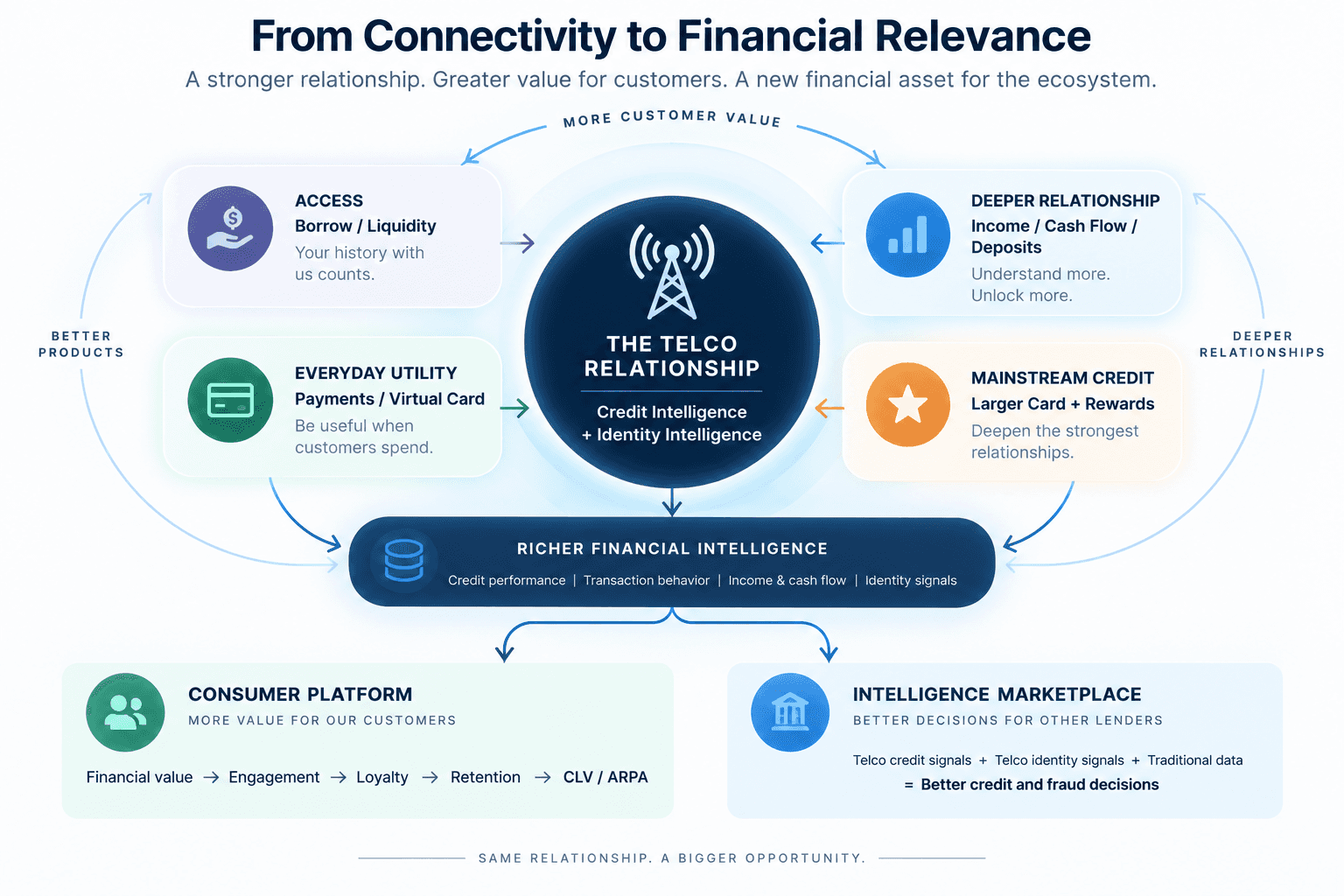
Borrow can make the carrier matter
Imagine a customer whom conventional underwriting sees as a 580 FICO.
The carrier might also see:
580 FICO
six-year relationship
multiple devices successfully financed
stable account behavior
strong repayment history
consistent identity and device relationship
None of that should automatically mean approval.
But if those signals allow the carrier to responsibly extend $50, $150 or $300 of general-purpose credit when the customer needs it, the carrier has created something meaningfully differentiated.
The consumer proposition isn't:
Here's another financial product.
It's:
Your history with us counts.
That can matter much more than the economics of the initial loan.
Connectivity is essential, but largely invisible when it works. Consumers rarely think positively about their carrier simply because their phone connected this morning.
Financial access is different.
If a company helps someone access credit at a moment when they genuinely need it, that company can become meaningfully more relevant.
The relationship can move from:
“They provide my phone service.”
to:
“My relationship with them gives me access when I need it.”
And that leads to an important strategic insight:
The customers for whom the carrier can create the greatest incremental financial value may also be the customers for whom that value creates the greatest incremental loyalty.
That is why Borrow is such an interesting place to start.
Not because every customer needs Borrow.
And not because a small-dollar loan is necessarily the largest revenue pool.
But because it may be where the carrier's unique information can create the largest difference in the customer's financial outcome.
A customer who performs well on Borrow might gain access to more credit or better terms.
For another, making that credit instantly spendable through a debit card could make it substantially more useful—and move the carrier relationship into everyday commerce.
Some customers may choose to bring income or funds into the relationship in exchange for greater availability, better economics or additional benefits. That gives the carrier visibility into income and cash flow.
Others may eventually support a much larger revolving card relationship with mainstream credit, rewards and benefits.
And prime customers may enter directly through the card.
The carrier doesn't need every customer to use every product.
The strategy is simpler:
Identify where proprietary telco information allows the carrier to create differentiated financial value. Win those customers. Then deepen the relationships where both customer value and economics support it.
Most conventional card programs begin by competing to acquire an attractive card customer.
This strategy can develop some of those relationships instead.
A customer whom the carrier helped with Borrow, observed successfully repaying, and perhaps came to understand through transactions or cash flow is different from a prospect acquired with a welcome bonus.
The carrier has potentially helped that customer establish a broader financial relationship.
As the relationship deepens, it may support larger limits, revolving credit, richer rewards and substantially more spend.
The card therefore doesn't disappear from the strategy.
Quite the opposite.
Borrow can be the strategic wedge. The larger card relationship can become the economic engine.
And because the carrier has tens of millions of existing relationships, a successful card program can still reach prime customers directly while the proprietary-data strategy expands the population the carrier can serve intelligently.
From Connectivity to Financial Relevance
The real prize is relevance
This is the part of the financial-services opportunity that can be easiest to underestimate.
Telcos have enormous distribution but relatively little consumer attention.
Financial services can change both the frequency and nature of the relationship.
Borrow makes the carrier relevant when a customer needs financial access.
A card makes the brand present when that customer spends.
Rewards and benefits reinforce the value of keeping and deepening the broader relationship.
That creates a potential strategic chain:
Unique financial value → relevance → engagement → loyalty → retention → higher customer lifetime value
And potentially, over time, higher ARPA as customers consolidate more value into the relationship.
Retention is therefore not an incidental benefit of the strategy.
It is one of the reasons financial services can be more valuable to an ecosystem than to a standalone lender.
But it should be measured rigorously. Customers who adopt financial products and stay longer may already have been more loyal. Correlation isn't proof of causality.
The strategic hypothesis is that creating unique financial value increases loyalty.
The business needs to measure whether it actually does.
The intelligence gets better as the relationship deepens
There is another compounding effect.
A carrier can begin with:
Telco relationship + identity + device-credit performance
Depending on how a customer engages, it can progressively add:
+ unsecured-credit performance
+ transaction behavior
+ income and cash flow
+ revolving-credit behavior
The carrier becomes progressively less dependent on the original telecom signals because it is developing an increasingly rich view of the customer's actual financial behavior.
That is where the ReScore concept becomes particularly interesting.
Instead of relying predominantly on a static history of prior borrowing, the platform can develop a more current and multidimensional understanding of financial health and creditworthiness.
Cash App Score demonstrates one version of that model today.
And Block is now taking the next logical step.
From consumer platform to intelligence marketplace
Block didn't stop at using Cash App Score to underwrite Cash App Borrow.
Through Nova Credit, it is making that intelligence available to outside lenders for products including credit cards, auto loans, personal lending and device financing.
A carrier could eventually create a similar two-sided opportunity.
Serve its own customers better
Use proprietary credit and identity intelligence to create better outcomes across Borrow, cards, payments, rewards and other financial products.
The carrier generates direct financial economics while becoming more relevant to the consumer.
Help other lenders serve consumers better
With appropriate consumer permission, another lender could potentially combine:
Traditional credit information
Telco credit signals
Telco identity signals
=
A richer credit and fraud decision
That does not require the carrier to become a credit bureau.
Infrastructure partners could potentially distribute the intelligence through systems lenders already use—much as Nova Credit is now doing with Cash App Score.
There is also a separate distribution opportunity.
An established carrier credit relationship could potentially become available through third-party commerce and checkout platforms rather than requiring the carrier to recreate merchant acceptance itself.
These are two distinct models:
Telco-powered credit: distribute the carrier's credit relationship through third-party commerce.
Telco-powered intelligence: help another lender make a better decision on its own customer.
Both originate from the same underlying asset.
3. What could this be worth?
The economics look very different once the question moves beyond:
How profitable is a $100 loan?
Borrow can be the wedge.
The larger economic opportunity comes from the financial relationships that can be built around it—and from what those relationships may do to the underlying wireless business.
Das Nexus built a bottom-up model for a large U.S. carrier to understand what that could look like.
The results suggest this can become material at carrier scale.
By Year 5
~3.3M
Borrow customers
~$4B
annual Borrow volume
~$22B
annual credit-card spend
~$500M
annual financial-services value to the carrier
Including approximately $285M from the card program.
By Year 10
~4.7M
Borrow customers
~$6B
annual Borrow volume
~$59B
annual credit-card spend
>$1.1B
annual financial-services value to the carrier
Including approximately $850M from the card program.
And that’s just the direct economics. Then add the value of the wireless relationship.
Borrow matters strategically because it can allow the carrier to create differentiated value for a large population of underserved customers.
As these relationships deepen, some customers can graduate into cardholders with a deeper relationship to the brand.
A large carrier can generate roughly $150 of monthly postpaid account revenue, or around $1,800 annually, from the underlying wireless relationship.
That makes relatively small changes in customer lifetime value potentially meaningful at scale.
If financial services make the carrier more relevant—particularly for customers to whom it has provided unique financial value—the resulting engagement can potentially influence:
Retention
Customer lifetime value
Product penetration
Premium-plan adoption
ARPA
A standalone fintech largely monetizes the financial product.
A carrier can potentially create value twice:
Improve the economics of the financial relationship while simultaneously increasing the value of the much larger connectivity relationship.
And over time, the intelligence itself can create a third source of value.
That gives telecom three potential economic pools:
1. Financial-services economics
Borrow, cards, payments, account products and other credit products.
2. Core wireless economics
Engagement, retention, CLV and ARPA.
3. Platform economics
Third-party distribution of telco-powered credit and proprietary credit and identity intelligence.
Cash App offers an emerging model: use proprietary intelligence to serve customers directly, then make that intelligence available to other lenders.
A telco could do the same. It won’t provide every financial product its customers need—from auto and personal loans to premium credit cards. But its intelligence could help other lenders serve those customers better.
Serve customers directly where the carrier has a right to win. Help the financial system serve them better everywhere else.
Together, direct financial economics, stronger customer relationships and an external intelligence platform make the opportunity much larger than any single financial product.
The Fintech business is already there. The opportunity is to turn it into real customer loyalty.
Telcos don’t need to start from scratch. Major carriers already offer device financing, credit cards and other financial products. But these have historically been largely ancillary businesses, with limited integration into the core customer relationship.
The opportunity is to approach financial services differently.
Use proprietary intelligence where it can create differentiated value. For a customer who may struggle to access credit elsewhere, the ability to provide even $100 at the moment they really need it can be far more meaningful than another rewards offer. If the carrier can responsibly say yes because it understands a customer whom traditional underwriting does not, that moment can create loyalty that lasts far beyond the loan itself.
Use financial services to deepen the relationship. As customers demonstrate performance, expand the relationship where their needs and the economics support it - larger credit, payments, cards and other products.
Compete differently for prime customers. Use the economics and benefits of the broader wireless relationship to create compelling rewards and make the carrier more relevant in everyday spending.
Build the intelligence as deliberately as the products. Every financial interaction can enrich the carrier’s understanding of credit, identity and financial behavior and make the next decision better.
And don’t stop at the carrier’s own products. Telcos will never provide every financial product their customers need. The evolution of Cash App Score points toward a broader ambition: use proprietary intelligence to help customers get better financial outcomes, whether the product comes from the carrier itself or from another provider.
The opportunity is to put the carrier’s unique relationship and intelligence on the customer’s side, helping them access better financial products, ideally first-party but also third-party products where suitable, while turning financial services into a powerful driver of loyalty and long-term customer value.
Want to go deeper?
Das Nexus has developed a detailed bottom-up model of the telecom financial-services opportunity, including Borrow, credit-card economics, customer adoption, credit performance and long-term carrier value.
Contact Das Nexus for more details.
Sources
Consumer Intelligence Research Partners (CIRP) data, cited by CNN Business, February 7, 2025.
T-Mobile US, Inc., Form 10-Q, June 30, 2026; equipment installment-plan receivables.
Block / Nova Credit, Block Will Open Its Cash App Score to Lenders with Nova Credit's Cash Flow Intelligence Platform as Partner, September 1, 2026.
Consumer Financial Protection Bureau, corrected estimates from Who Are the Credit Invisibles?, June 23, 2025.
GSMA Intelligence, GSMA Open Gateway: State of the Market, H2 2025.
T-Mobile US, Q2 2026 reported postpaid ARPA and account metrics.
Financial figures are illustrative outputs from a Das Nexus bottom-up model and are not forecasts. Results depend on assumptions including customer adoption, credit performance, card penetration, spending, program economics and partner structure.