
7

By
Anand Sivadasan
Founder, Das Nexus
The modern card system is one of the great networks of the last century.
It gave consumers the ability to walk into millions of merchants and pay with a card issued by a bank the merchant had never dealt with. Card networks created the standards, connectivity and trust that made this possible. Issuers extended credit and took risk. Merchants gained access to enormous consumer purchasing power.
Interchange helped make the economics work.
Over time, the system evolved into something much bigger than payments. Consumers learned to love points, miles and cash back. And some of the world's largest merchants and consumer brands discovered that a card could become a powerful acquisition and loyalty product.
They built co-branded credit cards.
Amazon, Costco, airlines and other scaled brands have demonstrated what can happen when merchant distribution, loyalty economics and financial services come together. The best programs can deepen loyalty, increase spend and create meaningful economics for both merchant and issuer.
But decades after the card system was created, one thing remains remarkably unchanged:
The underlying economics are still relatively static—and the ability to turn them into strategic advantage remains concentrated among the largest merchants.
That creates an opportunity for commerce platforms to build something new.
Not a replacement for the card networks. A new financial network on top of them.
Part 1: The co-brand is one of commerce's great financial products
There is a reason the co-brand has endured.
It solves a powerful equation.
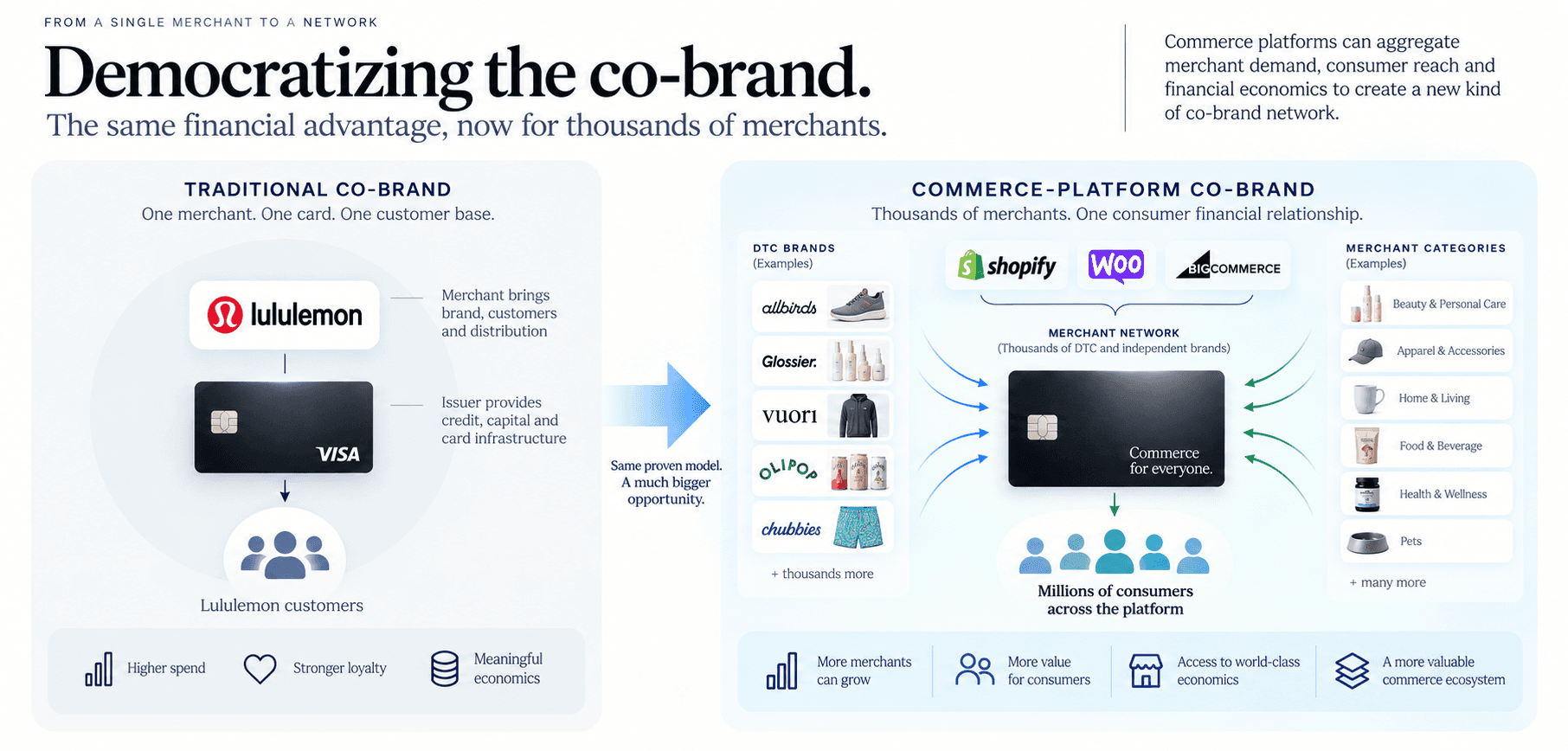
The merchant brings customers, brand and distribution. The issuer brings credit, capital and financial infrastructure. Card economics help fund rewards. Consumers receive something meaningfully better because of their relationship with the merchant.
At sufficient scale, the result can become a flywheel:
Better rewards → greater card adoption → more spend → stronger economics → greater loyalty
The most sophisticated programs go further. The card becomes embedded in acquisition and commerce itself.
A customer can encounter the card while shopping, receive immediate value and use it to complete the transaction. Rewards bring the customer back. The merchant gains a persistent financial relationship that extends beyond an individual purchase.
That is enormously valuable.
But it is also difficult to replicate.
Part 2: The card network is universal. The co-brand advantage isn't.
Millions of merchants participate in the card ecosystem.
Far fewer can build a great co-brand.
A large merchant can bring millions of customers to an issuer, negotiate bespoke economics, distribute a card throughout its customer journey and build a proprietary rewards proposition.
Most merchants cannot.
They still accept cards and pay the cost of acceptance, but they don't have the scale to turn financial services into the same acquisition and loyalty engine.
Even among the world's largest merchants, there has long been tension over interchange and the value received in exchange for acceptance costs.
The issue isn't that the card networks failed.
Quite the opposite: they succeeded in creating a nearly universal payment network.
The opportunity is to build on that foundation and distribute more of the strategic upside of financial services across commerce.
What if thousands of merchants could access the economic power of a great co-brand without each having to build one?
Commerce platforms may be uniquely positioned to make that possible.
Part 3: Commerce platforms can create a co-brand network
Commerce platforms aggregate what individual merchants lack: scale.
But increasingly, they aggregate much more than merchants.
A commerce platform can potentially connect:
Consumer → Merchant → Store → SKU → Checkout → Payment
That combination matters.
A bank understands the financial relationship. An individual merchant understands its own products and customers.
A commerce platform can increasingly understand the commerce relationship across a network of merchants.
That changes what a co-brand can be.
The traditional model is essentially:
One major merchant × One financial relationship × One rewards proposition
The commerce-platform model can become:
Thousands of merchants × One consumer financial relationship × A dynamic rewards network
Instead of requiring every independent merchant to create its own financial program, the platform can aggregate those merchants into a single network.
The platform doesn't just aggregate merchants' technology. It can aggregate their financial power.
This is the untapped financial network hiding inside commerce platforms.
Part 4: Reinvent the co-brand as a programmable network
A card that simply works across thousands of merchants isn't enough.
General-purpose cards already do that.
The real opportunity is to make the economics and value proposition programmable.
Traditional card rewards are relatively static.
Spend $100. Earn 1%, 2% or 3%.
But $100 of spend does not have the same economic value to every merchant—or even to the same merchant in every situation.
A merchant might be willing to spend $30 to acquire a valuable new customer. Another might fund an incentive to reactivate a customer who hasn't purchased in six months. Another might want to increase basket size. Another might want to drive a particular SKU or category.
Yet the financial proposition presented to the consumer rarely reflects all of that context.
This isn't a new problem. In 2019, I wrote about a future payment system in which merchant economics could become dynamic, potentially down to the SKU level, and translate into better financing and rewards for consumers.
Commerce platforms make a version of that idea much more practical.
A merchant could tell the platform what it wants to achieve:
Acquire customers.
Reactivate customers.
Increase average order value.
Drive a category or product.
The financial network can then determine what proposition to put in front of which consumer.
The consumer might see:
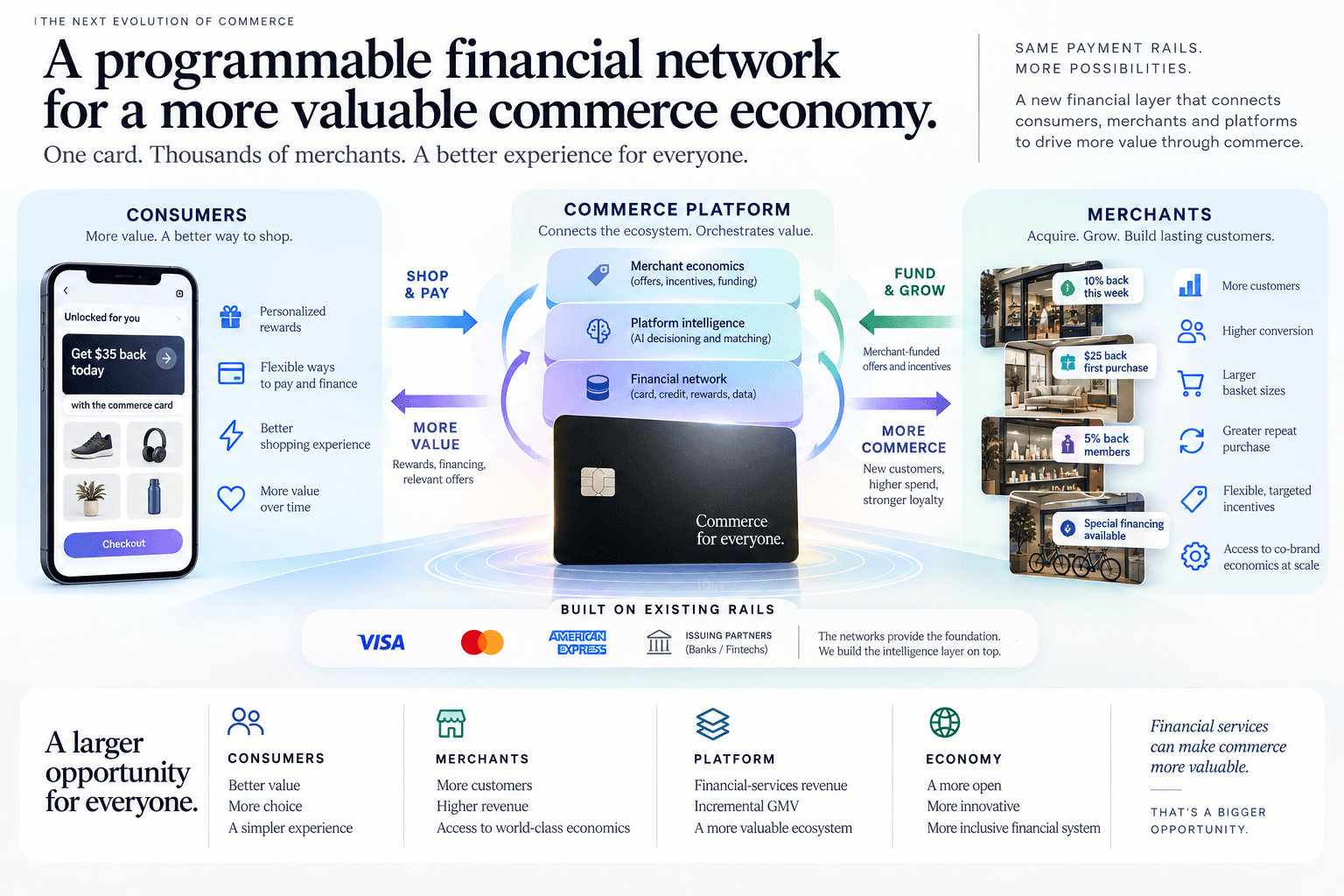
Get $25 back on your first purchase here at that merchant (merchant funded).
Or:
Get 10% back here this week (merchant + program funded).
Or directly in merchant checkout:
Apply for this card and get $35 toward purchase (program funded).
The economics can come from multiple places:
Card economics + Merchant funding + Platform economics + Rewards currency
The result is a fundamentally different co-brand.
Instead of one static value proposition, the co-brand becomes programmable by merchant, consumer and moment.
And every merchant on the platform can potentially participate.
Part 5: Merchant-funded rewards finally have a natural home
Merchant-funded rewards aren't new.
The industry has built card-linked offers, affiliate networks, loyalty programs and numerous other mechanisms designed to connect merchant marketing dollars with consumer rewards.
But they have struggled to become a seamless, scaled layer of the payment experience.
Commerce platforms have a structural advantage because they can bring the merchant and transaction much closer to the financial relationship.
And AI can make the matching increasingly intelligent.
The platform can ask:
Who is this consumer?
What are they considering buying?
What outcome does the merchant want?
How valuable would that outcome be?
What incentive is likely to change behavior?
Which pool of economics should fund it?
This changes the role of rewards.
Instead of simply returning a relatively fixed percentage of transaction value to the consumer, rewards can become a mechanism for matching merchant economic intent with consumer value.
AI doesn't need to be the product. It can be the intelligence underneath it—continuously optimizing the proposition across thousands of merchants and millions of consumers.
Part 6: Build on the card networks, don't replace them
This opportunity does not require dethroning the existing payment networks.
The networks are the baseline.
They solved an extraordinarily difficult problem: allowing consumers, merchants, issuers and financial institutions to transact reliably at enormous scale.
A commerce financial network can sit on top of those rails and solve a different problem.
The existing network answers:
Can this consumer pay this merchant?
The new layer can answer:
What is the best financial proposition for this consumer and this merchant at this moment?
The first requires ubiquitous payment infrastructure.
The second requires merchant participation, commerce context, consumer relationships and intelligent decisioning.
Those systems are complementary.
The next evolution of commerce doesn't need a new set of payment rails. It needs a more intelligent economic layer running on top of the rails we already have.
Part 7: The financial opportunity can be significant but the commerce opportunity may matter even more
The scale becomes interesting quickly for a large commerce platform.
Consider an illustrative upside case for a large commerce platform.
By Year 5, the program (US alone) reaches approximately 6 million active card accounts and $28 billion of annual card spend, including approximately $8+ billion spent across merchants on the platform.
By Year 10, it reaches approximately:
~15 million active card accounts
~$80 billion annual card spend
~$24 billion annual spend across platform merchants
~$1.3 billion annual direct financial-services revenue
Those numbers alone would represent a meaningful financial-services business.
But they miss perhaps the most important part of the thesis.
The card can make commerce itself bigger.
Based on Das Nexus's own work across co-brand and merchant-funded loyalty programs, well-designed programs of this kind typically drive somewhere between 25% and 40% incremental spend at the anchor merchant — spend that wouldn't have happened without the card.
$8 billion of incremental annual GMV
At steady state, annual incremental GMV can be between $6 and $10 billion.
That is the more strategically interesting number.
The opportunity isn't simply to build a billion-dollar financial-services business alongside commerce. It is potentially to build a $1 billion+ financial-services business that simultaneously creates tens of billions of dollars of incremental commerce for the merchants participating in the network.
All of the above is scoped to the United States. The opportunity is global.
Shopify operates in more than 175 countries. The same mechanics — a persistent financial relationship, a programmable merchant-funded network, a card as the anchor — apply well beyond the US. In our view, several international markets represent particularly large versions of this same opportunity: the UK, Canada, Germany, Japan, Australia, and Mexico among them.
A traditional co-brand primarily optimizes the financial economics and loyalty relationship of one large merchant.
A commerce-platform co-brand can potentially optimize:
Financial-services economics + Consumer loyalty + Merchant growth + Platform GMV
The financial product can become an engine for the underlying commerce business.
Part 8: The co-brand is the anchor, not the end state
Once a commerce platform establishes a persistent consumer financial relationship, the network can extend beyond the card.
The same relationship can connect:
Credit card for everyday spend and rewards.
Installments for transaction-level financing.
Merchant-funded offers for acquisition, reactivation and loyalty.
Platform rewards earned and redeemed across the merchant network.
Payment orchestration that helps determine the right way to pay or finance a transaction.
Over time, other consumer and merchant financial products can connect to the same network.
But the co-brand is a particularly powerful place to start because it connects three things that have historically been difficult to bring together:
A persistent consumer financial relationship.
The economics of thousands of merchants.
The moment of commerce itself.
The untapped financial network
The first generation of card networks connected financial institutions and merchants at unprecedented scale.
The co-brand added another layer. It showed that when merchant economics and financial services are deliberately combined, the card can become a powerful engine for consumer loyalty and commerce.
But that advantage has largely belonged to companies with enormous scale.
Commerce platforms can change the equation.
They can aggregate thousands of merchants into a shared co-brand network. They can allow merchants to contribute economics when a transaction is particularly valuable. They can combine those economics with card rewards and platform value. And AI can increasingly determine the right proposition for each consumer, merchant and moment.
All of it can operate on top of the payment networks that already connect global commerce.
The next great co-brand may not belong to a single merchant. It may be a programmable financial network connecting thousands of merchants to millions of consumers.
If commerce platforms can build that network, the prize is bigger than card revenue.
It is a financial system that can make the underlying commerce network more valuable for consumers, merchants and the platform itself.
Want to go deeper?
Das Nexus has developed a detailed bottom-up model of the commerce-platform financial-services opportunity, including card adoption, card spend, merchant-network spend, direct financial-services economics and incremental GMV.
Contact Das Nexus for more details.
Financial figures are illustrative outputs from a Das Nexus bottom-up model and are not forecasts. Results depend on assumptions including card adoption, card spend, on-platform spend, incrementality, program economics, merchant participation and partner structure.