
—
By
Anand Sivadasan
Founder, Das Nexus
Fintech has come a long way
Modern fintech began with a simple question: why couldn’t financial services work more like the rest of the internet?
Over the last fifteen years, the industry made enormous progress answering it. Payments became easier to accept and increasingly programmable. Banking moved from branches to phones. Financial infrastructure became accessible through APIs. New approaches to credit expanded access. Real-time payment networks demonstrated that money could move instantly and inexpensively at enormous scale.
I had a front-row seat to parts of this transformation across Capital One, Citi, Goldman Sachs and PayPal—building and partnering across cards, lending, payments, commerce and BNPL.
The first generation of fintech made financial services dramatically more accessible, digital and modular.
The system became more digital. But not necessarily more efficient.
New products, apps, wallets, lenders, aggregators and other intermediaries increasingly sit between where money originates, where financial decisions are made, and where that money is ultimately used.
For years, the idea was that every company would become a fintech company. Technologically, that has largely proven true. But commercially, the right to win has never been evenly distributed. Some participants sit in uniquely valuable positions in the flow of money—and have structural advantages others simply don't.
The individual pieces of financial services have become dramatically better. The system itself has not necessarily become more efficient.
The next phase could shift where value accrues.
As modern infrastructure removes many of the technology constraints that once required layers of specialized intermediaries, participants with a natural right to win can play a much larger role in financial services.
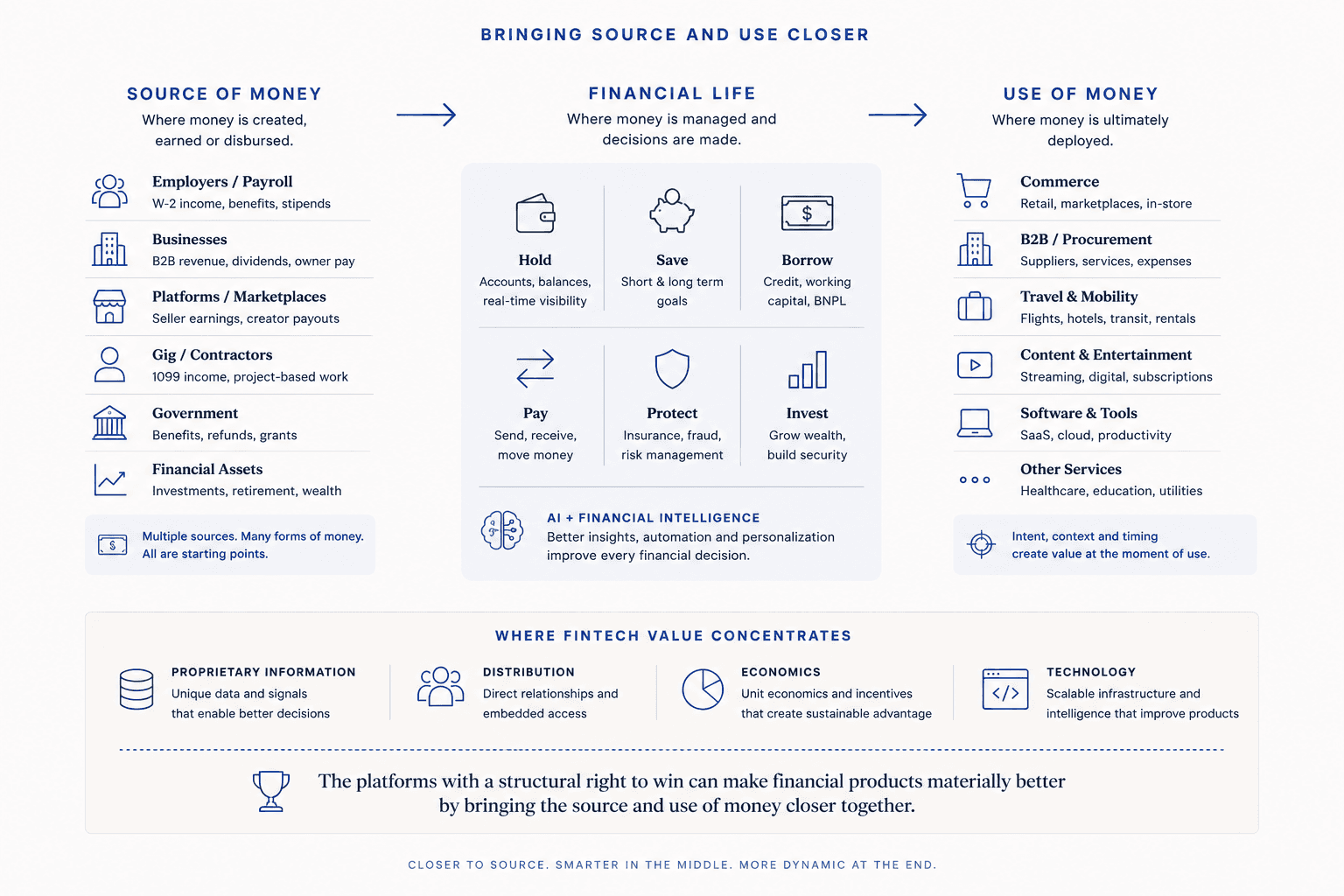
Start with the source of money.
Money enters the financial system from many places. Employers pay employees. Businesses pay suppliers and other businesses. Platforms pay sellers, creators and gig workers. Governments make disbursements. Financial assets generate income.
Yet financial services often begin after that money has already moved elsewhere.
This creates an opportunity to bring the source and use of money closer together—reducing unnecessary friction, improving information and creating better economics along the way.
Employers are one particularly powerful example. Income, benefits and employment relationships already sit at the source. Connecting financial products more directly to that source can create better economics, better information and more efficient access to financial services.
But employers are not unique. Different ecosystems can have a right to win at different points in the flow of money—through proprietary information, distribution, economics or technology. The opportunity is to identify where those advantages can make the underlying financial product materially better.
In the middle, AI can increasingly help consumers and businesses manage their financial lives. Instead of requiring people or companies to constantly optimize across disconnected products, an intelligent layer can help decide where to keep cash, which debt to repay, when to refinance, how much to save or invest—and which payment method, financing option or offer to use for a particular transaction.
And at the point of use, commerce can become more dynamic. Payments, credit, offers, loyalty and even access to digital content can increasingly adapt to the economics and context of an individual transaction rather than forcing every transaction through the same model.
Closer to the source. Smarter in the middle. More dynamic at the point of use.
Why now
For the first time, much of the infrastructure needed to connect these pieces is emerging at once.
AI, including LLMs and increasingly capable agents, can reason across information and act on behalf of consumers.
APIs and open banking can connect financial products and data that historically lived in silos.
HR, benefits and payroll systems are being rebuilt as modern, API-enabled platforms. Employment, income, benefits and payroll data are becoming easier to connect, creating the infrastructure to bring financial services closer to where money originates.
And new payment infrastructure, including stablecoins, can make value more programmable, global and inexpensive to move.
None of these capabilities alone defines the next generation of fintech. What becomes interesting is what they make possible together.
The first generation of fintech made the pieces better.
The next generation has an opportunity to make the pieces work better together.
Four Illustrations to bring this to life.
01 - Employer Financial Services
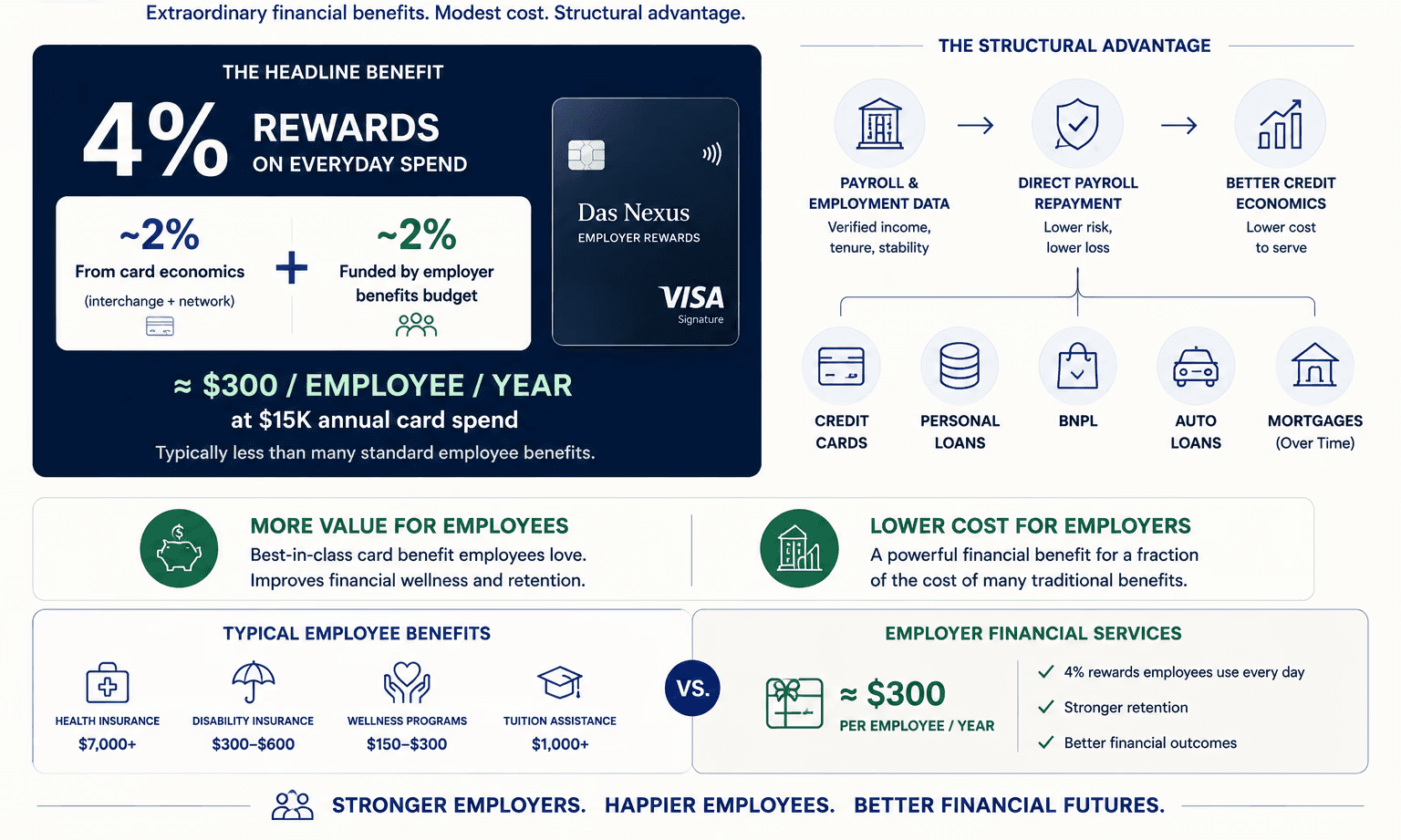
What if an employer could give employees a best-in-class 4% rewards card for roughly $300 per employee per year?
That’s less than the cost of many conventional employee benefits—and the card is only the beginning.
For most consumers, the most important financial event happens every two weeks: their employer pays them. Yet the employer sits surprisingly far away from most of the financial products employees use after that money arrives.
Employment brings together something unusual: distribution, a benefits budget, verified income, employment data and potentially repayment infrastructure.
Start with a credit and debit card.
A strong credit-card rewards proposition might return roughly 2% of spend before economics become increasingly difficult within traditional interchange constraints.
An employer has another source of economics: the benefits budget.
Suppose a professional employee spends $15,000 annually on a card. An additional 2% employer contribution costs approximately $300 per employee per year.
Relative to many existing employee benefits, that’s modest.
Yet combined with the economics already generated by the card, it could create a sustainably differentiated 4% value proposition for employees.
But rewards are only the beginning.
Employment is also the source of income.
With appropriate consumer permission and safeguards, payroll history, income stability and employment trajectory can provide additional signals for underwriting. Repayment can potentially occur directly from payroll, reducing uncertainty and servicing friction.
Those advantages can support better credit economics—not just for cards, but potentially for personal loans, installment credit and, over time, larger financial products such as auto loans and mortgages.
The idea isn’t another workplace distribution channel for ordinary financial products. Financial institutions have tried versions of “at work” distribution before.
The more interesting model is to turn employment itself into financial infrastructure:
Employer-funded economics + employment data + payroll distribution + repayment infrastructure
That combination can potentially create financial products that are structurally better than what the same employee can obtain independently.
The employer becomes more attractive.
The employee gets better financial products.
And the financial provider acquires customers through a lower-cost channel with potentially better information and repayment economics.
02 - ReScore
Going beyond alternative data sources and open banking
While credit underwriting has become considerably more sophisticated in the last decade, CFPB report on credit cards still shows 1 in 2 credit card applicants are declined by card issuers today. Current crop of fintechs are very good at understanding based on what has happened financially. It is not yet capable of understanding where a consumer is going.
Two people can have similar credit files today while having very different income trajectories, economic resilience and likelihood of successfully navigating a future financial shock.
What if consumers had a way to prove that their future looks different from their past?
Imagine a consumer-facing product called ReScore.
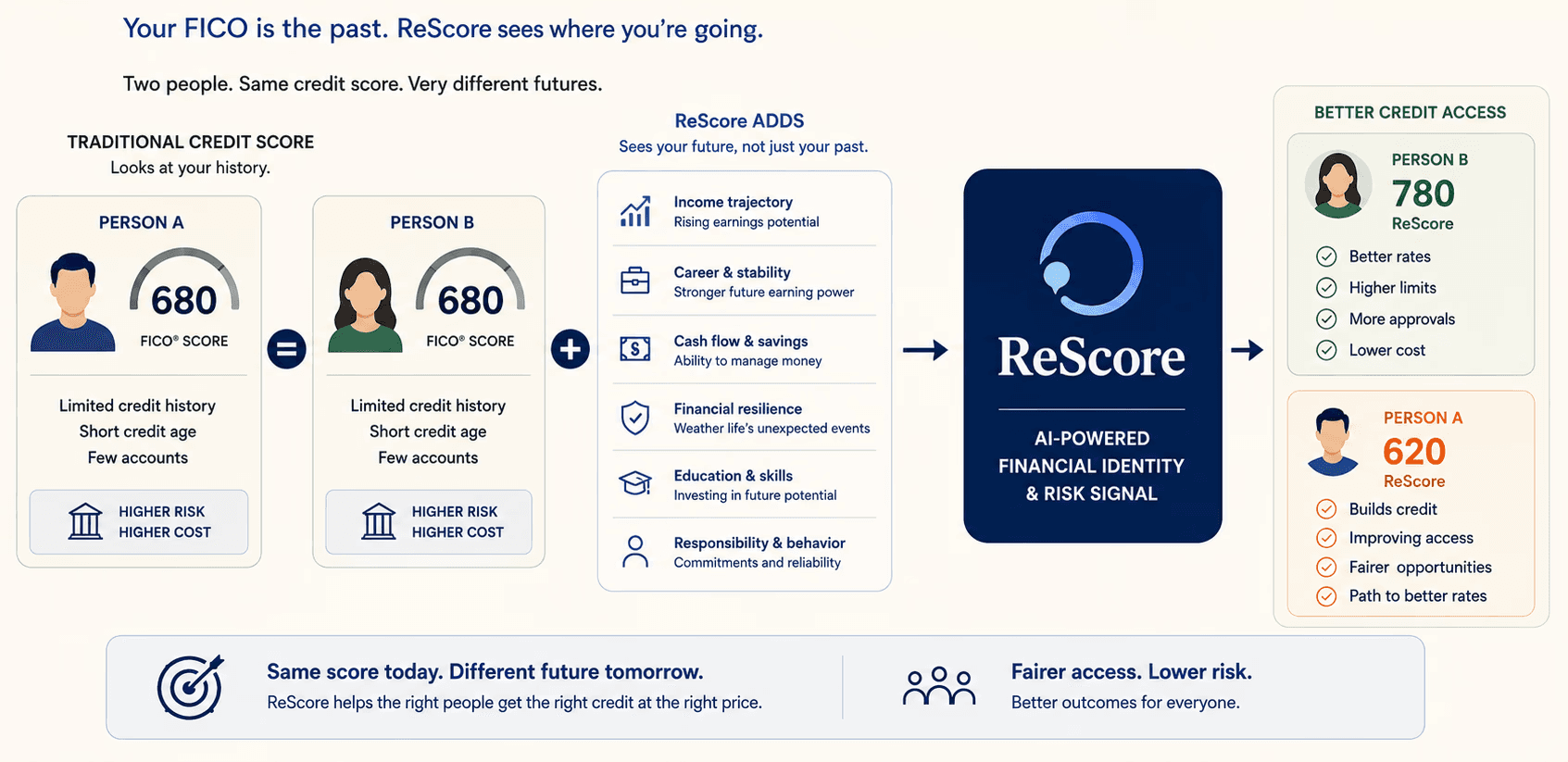
A consumer who believes their traditional credit profile understates their creditworthiness could actively build a richer financial identity.
They might connect bank accounts and income information, but also voluntarily provide additional signals intended to demonstrate economic mobility and resilience—professional history, employment trajectory and structured in-app interactions designed to understand how they make financial decisions.
ReScore would turn that information into an additional risk signal and then match consumers with lenders and products where that signal creates the greatest incremental value.
There are two reasons the population could be interesting to lenders.
First, consumers willing to go through the process may themselves be positively selected.
Second, if the additional information separates risk beyond bureau and cash-flow data, ReScore can identify creditworthy borrowers traditional underwriting misses.
Over time, the concept could become more powerful.
Rather than merely saying “we believe this customer is better than their credit score suggests,” ReScore could potentially put economics behind that conclusion—sharing or backstopping some portion of lender losses on customers it strongly believes are mispriced.
That creates a much stronger proposition:
Approve the customers we identify, and we’ll stand behind our assessment.
The regulatory, fair-lending and capital implications would need to be designed carefully. A model like this may ultimately require operating within the consumer-reporting framework rather than around it.
But the underlying opportunity is simple: give consumers a way to prove what conventional credit data cannot see.
03 - Personal Modern Treasury
Let AI optimize how you spend and manage money
Consumer finance has long rewarded those who know how to navigate its complexity.
Two consumers can purchase the same $2,000 television and experience very different economics. One might optimize rewards, offers and financing and effectively pay less than $2,000. Another might choose a more expensive way to pay and ultimately pay far more.
The answer may not be to make every consumer a financial expert.
It may be to give every consumer an agent that is sophisticated on their behalf.
Imagine an AI agent with permission to understand your financial life—your income, cash, debt, cards, rewards, investments and upcoming obligations—and a simple mandate:
Optimize for you.
Large companies have treasury functions that continuously manage liquidity, obligations, funding and capital allocation.
Consumers face smaller versions of the same decisions every day.
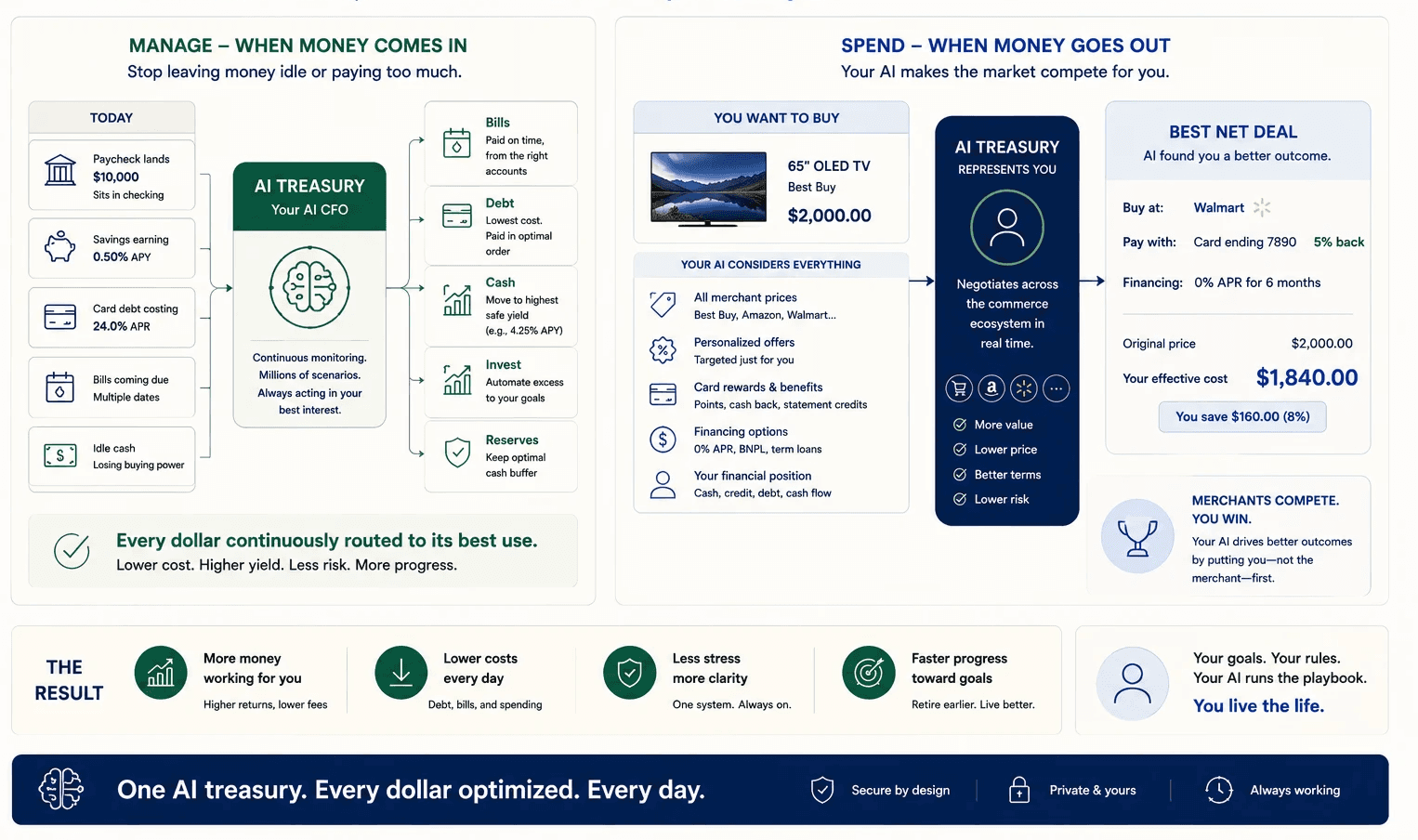
A Personal Modern Treasury would sit above the consumer’s individual financial products and continuously optimize their overall financial position.
Spend - optimize every transaction
Imagine standing at Best Buy purchasing a television.
At checkout, you authenticate with your financial agent. It understands your accounts, cards, rewards, balances, available credit and financial position. It can also see available merchant offers and financing options.
Instead of asking you to choose among them, it answers the question that actually matters:
What is my lowest net cost for this purchase?
Online, the same intelligence can appear earlier. A browser layer might recognize what you’re considering and identify a lower effective price elsewhere after accounting for merchant incentives, rewards and financing.
Initially, the agent can aggregate offers that already exist.
Over time, this can become a network.
The agent isn’t simply finding coupons. It represents consumer demand.
Merchants can compete for the transaction by communicating what they are willing to pay to win that customer’s business. Payment providers and lenders can compete on rewards, financing and economics.
The AI evaluates the entire package and determines the lowest net cost for the consumer.
Merchants could communicate what they are willing to pay to win a particular customer’s transaction. The agent then reconciles two objectives:
Minimize net cost for the consumer.
Maximize incremental customer lifetime value for the merchant.
The consumer doesn’t navigate that marketplace.
The agent does.
Manage - optimize every dollar
Now apply the same intelligence to a paycheck.
When money arrives, the consumer shouldn’t need to manually decide how much belongs in checking, which debt should be paid first, where excess cash should earn yield or how much can safely be invested.
The agent sees the entire financial position.
It can reserve enough liquidity for upcoming spending and bills, prioritize expensive debt, move excess cash into higher-yield savings, evaluate refinancing opportunities and invest what remains according to the consumer’s preferences.
Then circumstances change.
An unexpected expense appears: preserve liquidity.
A promotional APR is about to expire: prioritize the balance.
Savings rates change: move cash.
A cheaper refinancing opportunity appears: evaluate it.
Cash accumulates beyond the required buffer: save or invest it.
The objective is not to recommend each of these actions independently.
It is to continuously optimize the whole system.
That changes the relationship between consumers and financial institutions.
Today, every financial institution naturally optimizes the product it provides. The bank wants the deposits. The card issuer wants the spend. The lender wants the borrowing. The brokerage wants the investments.
The consumer’s AI has a different mandate: optimize the consumer.
That changes the competitive structure of financial services. Products increasingly become inputs into an optimization engine, and financial institutions compete to be selected.
The first generation of personal financial management gave consumers information.
The next generation can act.
Money comes in → allocate.
Money goes out → optimize.
That’s Personal Modern Treasury: one intelligent agent continuously making every dollar work harder for the person who owns it.
04 - Dynamic Content Commerce
Turn digital content into dynamic commerce market
Some of the most interesting opportunities in payments aren’t about creating another way to pay.
They’re about enabling valuable transactions that barely happen today.
Consider premium information.
I may subscribe to a few publications but regularly encounter valuable articles from publishers I don’t subscribe to. I may happily pay 30 or 50 cents for a particular article, but I’m unlikely to create another account and establish another recurring subscription to read it.
So I hit the paywall and leave.
The publisher created something I value enough to pay for, yet no transaction occurs.
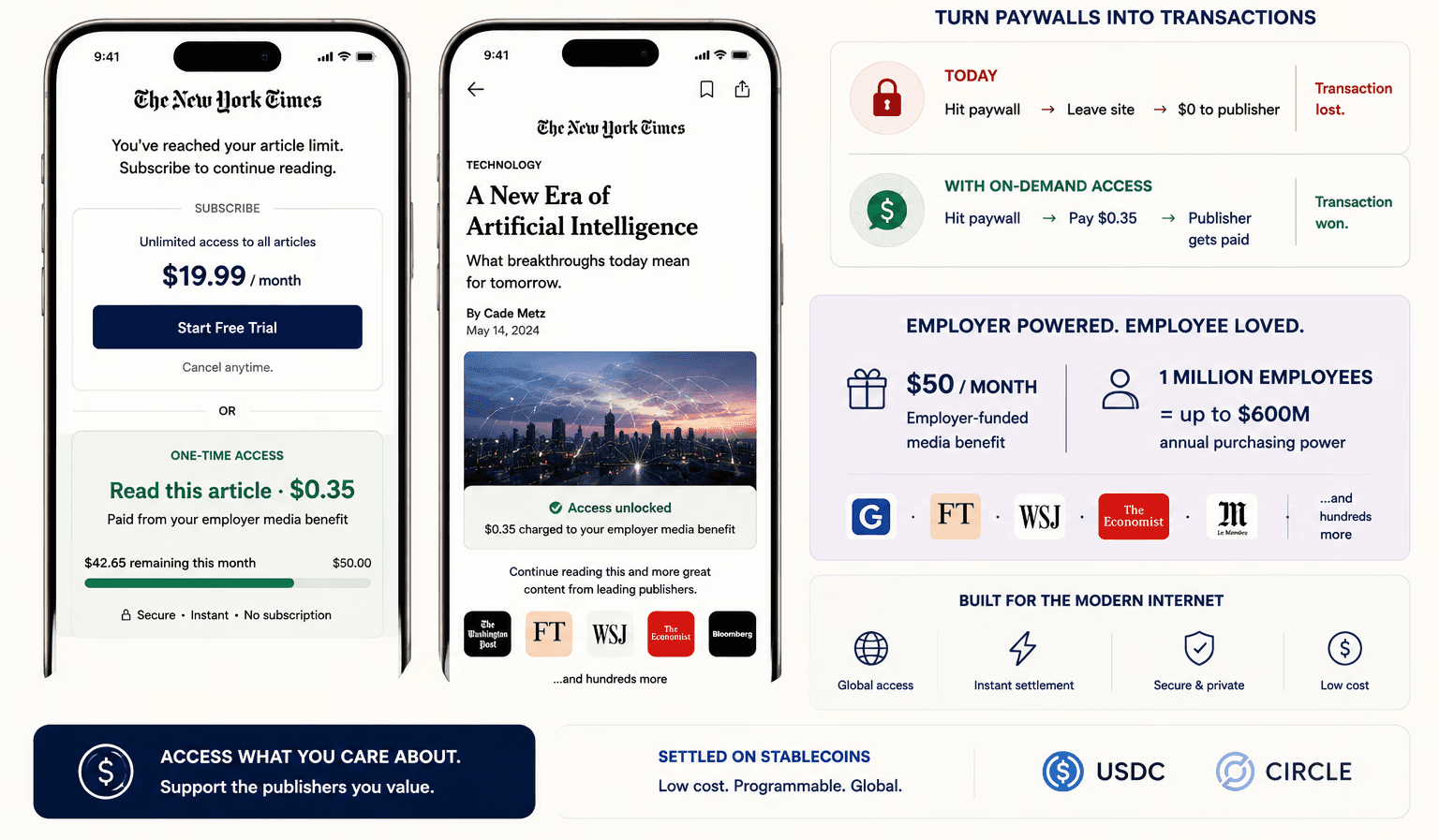
Imagine instead a universal access layer for premium information.
A publisher dynamically prices an article:
Read — $0.35
The consumer authenticates once with the network and can thereafter access individually priced content across every participating publisher.
No new payment relationship at each site. No new subscription.
The publisher sets the price. The consumer decides whether to pay. The network handles identity, authorization, ledgering and settlement.
The product is simple: one identity, one balance and access to premium information across the web without another subscription.
Every publisher can also become an acquisition channel.
A publisher might offer:
Join the network and read this article free.
That publisher has now helped acquire a customer who can transact across the entire network. In return, it gains access to customers acquired by every other participating publisher.
The network becomes considerably more powerful with a distribution and funding wedge.
Imagine an employer providing each employee $50 per month for premium information.
The benefit isn’t tied to one newspaper or database. Employees use it across participating publishers based on what they actually value. Unused benefits can roll forward during the year and expire at the employer’s fiscal year-end; personal funding can take over once the employer benefit is exhausted.
At one million participating employees, that’s as much as $600 million of annual purchasing power available to flow toward premium information.
That changes the publisher proposition.
The network isn’t simply bringing traffic.
It’s bringing funded readers.
It can also make readership more global. A U.S. professional researching Australia may value one article from an Australian publication without wanting an Australian subscription. A German professional may occasionally need a specialist U.S. publication.
A global employer can provide the same benefit across its workforce while employees spend it with whatever publications are relevant to them.
Stablecoins become particularly interesting underneath a network like this.
Micropayments themselves aren’t new; ledgering and batching small transactions has been possible for years. But a network processing millions of small transactions among consumers, employers and publishers across countries creates substantial settlement complexity.
Stablecoins can provide a low-cost, programmable, always-on global settlement layer underneath the network—while consumers and publishers continue interacting in familiar currencies.
And eventually the reader may not always be human.
An AI agent researching a topic could—with permission—spend a small portion of a consumer’s information benefit to access the premium sources required to produce a better answer.
That creates a potential payment mechanism for an emerging question facing publishers:
How should premium information be accessed and compensated when software increasingly consumes it on behalf of people?
In the coming weeks, I’ll explore other ecosystems where financial-services value may concentrate because of a structural right to win. Telecom is the first — combining credit relationships, distribution, proprietary technology and economics that could create a uniquely compelling environment for fintech.